Beetles Save Needles
Protecting Hemlock Forests Before It’s Too LateThe invasive Hemlock Woolly Adelgid is devastating native forests across North America. Your donation helps protect and restore threatened hemlock ecosystems.
NHLN Predation Study
Establishment and Impact of the Hemlock Woolly Adelgid predator Laricobius nigrinus (Coleoptera: Derodontidae) in the Harrisville New Hampshire area.
McDonald, R.C., Symbiont Biological Pest Management
R. Zingaro, White Mountain Horticultural Research Foundation
Lee Barnes, Barnes-Berry Trust
H. Wolhandler, Harrisville Conservation Committee
Scientific Paper
— Why Hemlocks Matter —
Vital to Our Forest Ecosystems
Eastern and Carolina hemlocks are foundational tree species that regulate stream temperature, prevent erosion, and provide habitat for wildlife. Without intervention, entire forest ecosystems will collapse.

Wildlife Habitat
Home to birds, trout, and countless species.

Water Quality
Shade keeps streams cool and healthy.

Climate Resilience
Stores carbon and stabilizes soil.
CLICK HERE to fortify and protect your valuable trees!
— The Threat —
The invasive Hemlock Woolly Adelgid is killing trees at an alarming rate.
Hemlock woolly adelgid (Adelges tsugae) was found in NC ~1995. It was reported in the Pacific Northwest in 1924 and in Virginia, 1954. Now established through most of the range of eastern hemlock, this prolific pest threatens the climax forests Adult HWA and eggs of eastern North America. Symbiont Biological Pest Mgt.
The HWA is a very small, burgundy colored, aphid-like insect with two generations per year, with no local, natural enemies. Once the insect settles at the base of a needle, it inserts its feeding tube and sucks the juices out. This causes bud mortality, twig dieback, and defoliation and, under high infestation rates, death of the tree in as few as 4-7 years.
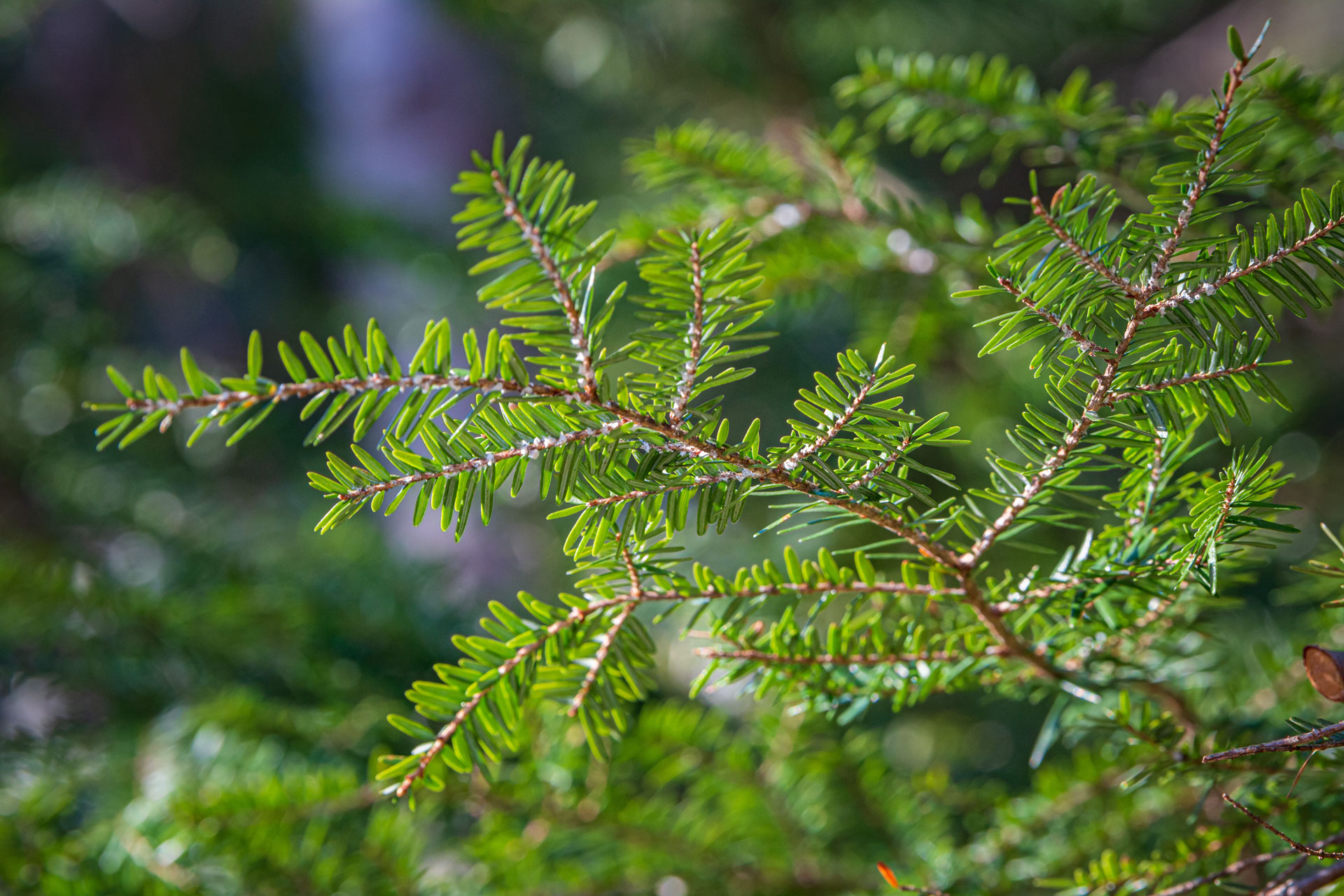
HWA can be easily seen from late fall through early spring with the presence of white cottony masses at the base of the hemlock needles.